
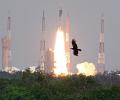
Indian Space Research Organisation is using the most powerful configuration of its rocket Polar Satellite Launch Vehicle to launch a communication satellite from Sriharikota on July 15, as it braces for the nearly Rs 200 crore mission.

The ISRO is aiming for a soft landing of the lander in the South Pole region of the moon where no country has gone so far.
The BJP hit back accusing the Congress of drawing the issue into political arena.

Indian skipper Virat Kohli, on Monday, lauded ace sprinter Hima Das for winning five gold medals in a span of 20 days.
The 51-hour countdown for the 17th flight launch of Indian space agency's Polar Satellite Launch Vehicle PSLV-C 15 from Sriharikota spaceport is expected to begin on Saturday morning."The rocket will put into orbit five satellites remote sensing satellite Cartosat-2B from India, Alsat from Algeria, two nano satellites from Canada and Switzerland, and a pico (very small) satellite called Studsat built by 7 Indian engineering students.
India's ambitious attempt to flight-test its indigenous cryogenic engine on Thursday received a setback as the homegrown rocket Geosynchronous Satellite Launch Vehicle (GSLV-D3) deviated from path within seconds of lift-off.
Indian Space Research Organisation is all set for the launch of the first flight-testing of indigenous cryogenic engine on homespun rocket, Geosynchronous Satellite Launch Vehicle (GSLV-D3), from the Satish Dhawan Space Centre at Sriharikota at 4.27 pm on Thursday.

Cartosat-3 satellite is a third-generation agile advanced satellite having high-resolution imaging capability.

The satellite would provide a thrust to mobile communication through multi-beam coverage facility, the ISRO said.

The launch of IRNSS IC, the third of seven satellites in the series to put in place India's navigation system at par with US' Global Positioning System, that was deferred following a technical snag has been rescheduled for October 16.
RISAT-2, India's spy satellite, was successfully placed into the 550 km orbit around Earth on Monday morning.Earlier, the PSLV-C12, carrying 300-kg Radar Imaging Satellite and 40-kg Micro Satellite ANUSAT, had lifted off from Indian Space Research Organisation's Satish Dhawan space Centre in Sriharikota today morning. The RISAT-2 has an all weather capability to take images of Earth.

The mission life of the 2,250kg GSAT-7A, built by ISRO, is eight years. It will provide communication capability to users in Ku-band over the Indian region.
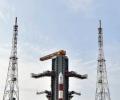
Here are some things you must know about this significant launch and why this satellite is a big deal for India.

Microsat-R, an imaging satellite, is meant for military purposes, but the ISRO did not give any details about it.
A "small" fuel spill mishap when the Polar rocket with the Chandrayaan-I spacecraft atop was being fuelled created a near "scare" during the final countdown for the launch of India's maiden unmanned moon mission, ISRO Chief Madhavan Nair said.
Click here to watch the live broadcast of the historic launch!
"It is beautiful to see the countryside. There are so many colours. I think I have mentioned that before how colourful it is being in India. From the space, it is the same," she said.

PSLV C-29 blasted off from the Satish Dhawan Space Centre, about 110 km from Chennai, at 6 pm and released the six satellites one by one into a 550 km circular orbit.
India on Friday moved a step closer to launch its maiden unmanned moon session when the lunar spacecraft Chandrayaan-I was mated with the polar rocket which is set to blast off on October 22 from the Sriharikota spaceport. Gearing up for the final countdown, Space officials said all operations for the mission are progressing satisfactorily and barring a cyclone threat the PSLV-C11 will keep the date with the country's historic mission on October 22.

Why did ISRO's workhorse Polar Satellite Launch Vehicle rocket fail during its 41st flight?
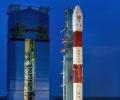
Antrix, ISRO's commercial arm, is eyeing 10% of the $357 billion global market.

The Indian Space Research Organisation successfully put India's heavy rocket Geosynchronous Satellite Launch Vehicle-Development 5 (GSLV-D5) into orbit from the spaceport at Sriharikota, Andhra Pradesh at 4.18 pm on Sunday.
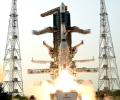
Over 32 missions -- satellites and rockets -- have been planned for the year.
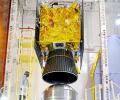
India successfully launched IRNSS 1C on board ISRO's PSLV C26 rocket from the spaceport at 1.32 am on Thursday, moving a step closer to setting up the country's own navigation system on par with Global Positioning System of the US.
This is the first time ISRO was putting into orbit a two-tonne class satellite.\n\n
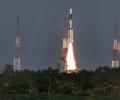
The satellite will enable a full range of services to neighbours including the areas of telecommunication, television, direct-to-home, VSATs, tele-education and tele-medicine.

PSLV C-35, carrying India's SCATSAT-1 meant for ocean and weather studies and seven other satellites including from the United States and Canada, on Monday lifted off from the spaceport in Sriharikota.

"I am extremely happy to announce that GSLV Mark III successfully injected Chandrayaan 2 in the defined orbit, infact the orbit is 6,000 km more than what was intended," Sivan said.

The stage is set for the launch of India's satellite IRNSS-1D on Saturday from Sriharikota onboard workhorse PSLV-C27 that would pave the way for the country's own navigation system on par with the GPS of United States.

The ISRO is strengthening 'eye in the sky', which helped the Indian army carry out surgical strikes last year, with the launch.
.jpg)
The 56 and-a-half hour countdown for the launch of India's first space mission to Mars, slated for November 5, commenced on Sunday at the Satish Dhawan Space Centre in Sriharikota.
The indigenous rocket will carry the second technology experiment satellite GSAT-2.

India is all set to script history by launching a record number of 22 satellites, including a number of micro and nano ones from foreign countries, in a single mission in May this year.

Except Pakistan, seven SAARC countries are a part of the project.
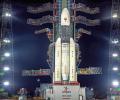
Late on Monday night, in a last-minute revision of schedule, ISRO announced that the launch of India's second lunar mission 'Chandrayaan-2' has been called off due to a technical snag.

India's Mars Orbiter Mission is slated to be launched on October 28 after a national committee of experts gave the go ahead for the Rs 450 crore ambitious venture after threadbare deliberations.

GSAT-6, the country's latest communication satellite has been successfully positioned in its orbital slot, Indian Space Research Organisation said on Sunday.

Around 600 scientists and engineers are hoping for the best as they forge ahead with plans of making an indigenous version of a space shuttle.

The Indian space agency has already begun work on the third generation of the earth observation satellite -- the first of which will be ready by 2018 and boost the capability to generate digital maps.

Scientists also expressed the hope that any technical problem will be sorted out by ISRO, and the mission will be launched successfully.
